
Victor Clopotar has worked copper his whole life. He belongs to the Căldărari, a Roma community in Transylvania that has worked metal for centuries. He makes cauldrons, kettles, coffee pots. Ask him what stands between him and a decent living and he will not mention skill. On Mesteshukar ButiQ’s own profile of him, the listed challenges are raw materials, distribution and access to market. Nicu Drăgăn carves wood in Băbeni, Vâlcea — an hour and a half up the road from Craiova. Third-generation craft, plates and platters and small furniture in poplar, lime, beech and willow. His challenges: raw material, transport, distribution, sales. Zoltan Bojody weaves wicker in Viișoara, Cluj, the third generation of his family to do it. His challenges: sales and distribution, competition, and the fact that the work is labour-intensive. Notice the pattern. Four craftsmen, four different trades, and none of them named the craft as the difficulty.
Mesteshukar ButiQ — MBQ — is a Bucharest-based social enterprise working to revalue traditional Roma craftsmanship. Its premise is unusual among social businesses: it does not begin by training its beneficiaries. It begins by assuming they are already excellent, and treats market access as the thing that is broken. Two problems get solved together. Roma families remain in poverty despite holding valuable, transferable skills. And Roma cultural heritage remains largely invisible to the Romanian public, which feeds the prejudice that keeps those families poor in the first place. MBQ works as a market intermediary. It does not employ the craftspeople. It connects a network of craftsmen and craftswomen from across Romania with product designers, develops collections, and then handles the part they cannot do alone: branding, photography, retail, e-commerce, export, international exhibitions. Every object sold generates direct income for the person who made it. Supported by the ERSTE Foundation Roma Partnership, MBQ has worked with Austrian designers Nadja Zerunian and Peter Weisz, Sweden’s Glimpt Studio, designers Mattias Rask and Tor Palm, and Romanian designer Radu Abraham, whose 2018 collaboration produced the award-winning “Contrasts” collection at Romanian Design Week.
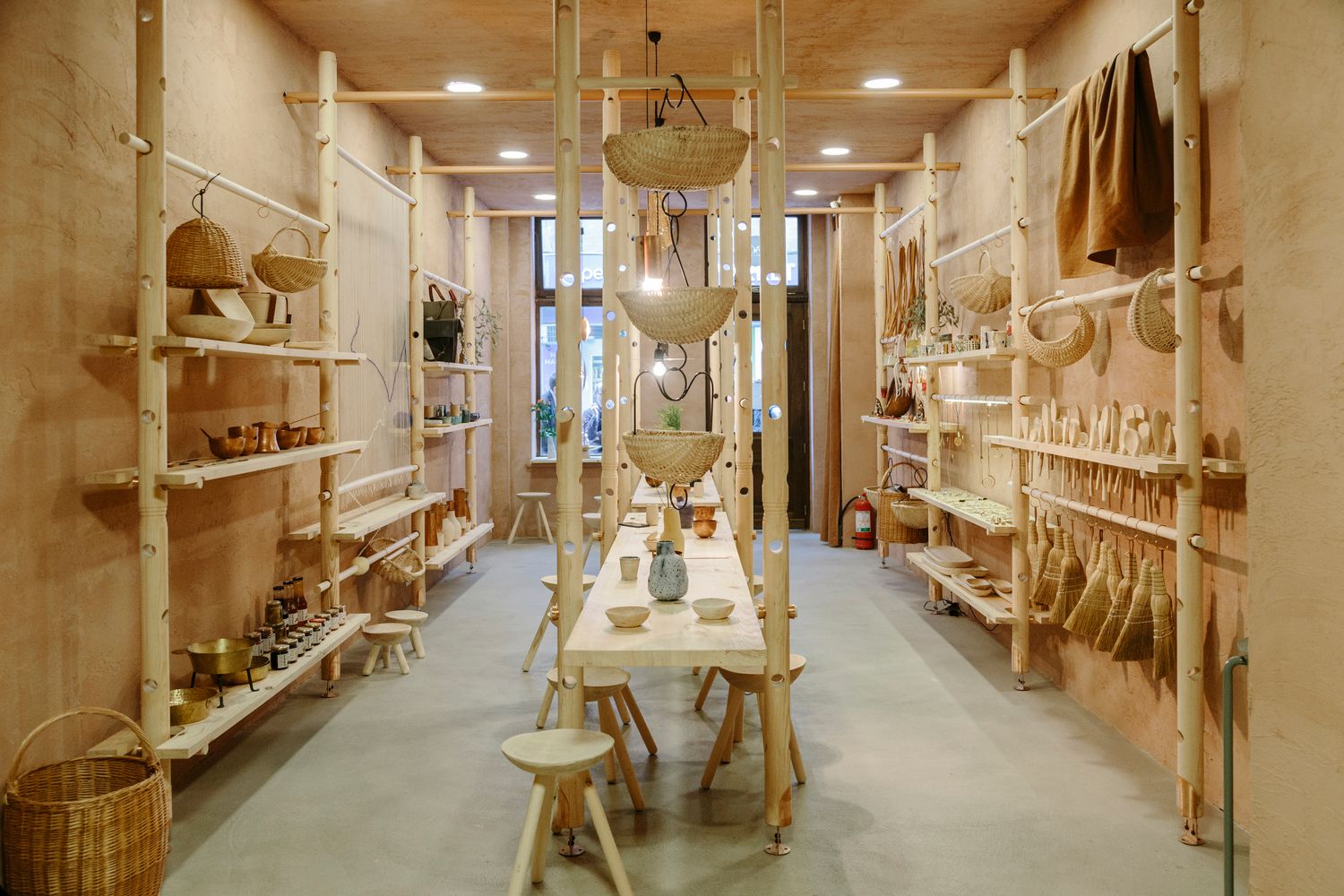
The collections are organised around the crafts themselves, named in Romani: Rupunarja for silver, Kakavjarja for copper, Rudarja for wood, Khuvarja for wicker. What the designers change is not the technique. It is the object. A coppersmith who has spent forty years making cauldrons for distilling brandy has a technique that transfers perfectly to a contemporary serving piece — but the cauldron market is shrinking and the design-object market is not. The craftsman keeps the skill, learns a new application, and reaches a customer who was never going to buy a cauldron. The products — jewellery, home decor and fashion in silver, gold, copper, brass, wood, wicker, leather and textiles — are sold through MBQ’s shop on Kogălniceanu 12 in Bucharest, through its online store, and at international events including Vienna Design Week, where MBQ presented during the festival’s Romanian country focus and opened a pop-up shop in the city.
Check the original article here!